
Description
Related products

Christopher Farr
Josef Albers Bauhaus Rug - Homage to the Square
In 1950, former Bauhaus master Josef Albers began his series Homage to the Square at the age of 62. Over the next 26 years, Josef Albers produced hundreds of...
1.260,00 €

Christopher Farr
Josef Albers Bauhaus Rug Full
The series Homage to the Square is considered one of Josef Albers most famous and important works.
1.100,00 €

Christopher Farr
Josef Albers Bauhaus Rug Equivocal
The series Homage to the Square is considered one of Josef Albers most famous and important works.
1.100,00 €

Christopher Farr
Anni Albers Bauhaus Rug
Based on a textile design by Anni Albers from the 1920s, the English manufacturer Christopher Farr Editions has created this motif as a tepee in two sizes.
From 800,00 €

Christopher Farr
Gunta Stölzl Bauhaus Rug
On the occasion of the 100th anniversary of the Bauhaus in 2019, the English manufactory Christopher Farr is reissuing several hand tufted textile designs by...
1.850,00 €

Christopher Farr
Gunta Stölzl Bauhaus Rug Plate 184
Gunta Stölzl brought modern art into handloom art and later became the first master at the Bauhaus.
1.840,00 €

Christopher Farr
Anni Albers Bauhaus Rug Temple Emanu-El
Based on a textile design by Anni Albers from the 1920s, the English manufacturer Christopher Farr Editions has created this motif as a tepee in two sizes.
1.750,00 €

Limited Edition
Bauhaus Rug Forms 47
The geometric shapes and lines on the rug cross, interact and repeat with subtlety and accuracy.
From 1.000,00 €

Limited Edition
Bauhaus Rug Lines 35
The geometric shapes and lines on the rug cross, interact and repeat with subtlety and accuracy.
From 1.000,00 €

Klein & More
Tea Table Josef Albers
The simple, straight-line and at the same time modern design of the Tea Table was created by Josef Albers.
550,00 €

THONET
Floor lamp LUM 125
Clear design, individual light: The luminaire floor lamp LUM 125
895,00 €

THONET
Table lamp LUM 50
Clear design, individual light: the LUM 50 table lamp
795,00 €

Tecnolumen
Wagenfeld Lamp WG 24
The legendary Bauhaus table lamp by Wilhelm Wagenfeld, WG 24. Craft meets avant-garde: opal glass, glass base, serial number — an art object and light source...
630,00 €

Tecnolumen
Bauhaus Floor lamp DSL 23
Clear forms and lines meet high functionality and sophisticated details.
2.320,00 €
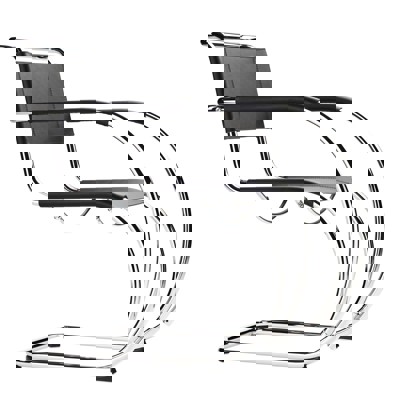
THONET
Cantilever Chair S 533 LF - Mies van der Rohe - 1927
Timeless elegance with the comfort of an armchair: the cantilever chair S 533 LF
2.490,00 €

ZigZagZurich
Gunta Blush Rug
This new production technique developed by ZigZagZurich combines a natural, unbleached, simply washed sheep’s wool (dark or light tone) combined with a bamb...
490,00 €